Bladerunner Tokyo (in Large-Format Photography)

The future began a long time ago in Tokyo...

I am fascinated by life in metropolitan areas, surrounded by millions of other people... I love neon signs and public video screens. AND rooftops. Everywhere. Concrete is romantic and beautiful to me.


Isolation in a crowded place, aglow with neon...

I went to Tokyo in the summer of 2008 for three weeks to take pictures of "the future". What I found was even more impressive. The future began a long time ago in Tokyo, and so the whole city has a face, there has been so much organic growth - there is no master plan, the city has been shaped by individuals' desires. The result is a structure that seems alive, even if you do not see the inhabitants, as usually the case with long-exposure photography .


I do Large Format Photography, currently on a Sinar P2 8x10 (basically I scouted locations on foot during

Narrow Buildings in Japan and Around the World

Narrow-minded architecture can be brilliant, indeed

If you looked closely at high-res photographs of Tokyo in our recent article, you may have noticed a few buildings that are apparently functional, housing either a business or a residence, but are extremely slim - sometimes not more than a meter in width. We got intrigued with this way of squeezing the most use out of every square foot, and decided to look at other examples in Japan and around the world.


In Robert A. Heinlein's short story "—And He Built a Crooked House—" rogue architect Quintus Teal builds a cross-shaped house that, because of a classic Los Angeles earthquake collapses not into 3 dimensional rubble but instead into a four-dimensional tesseract.
While we've yet to see any buildings with extra-rooms that cross space and time there are plenty of other houses out there that certainly look like they do.


Some call them "Godzilla's Dominoes", others "Pancake Houses"

The designers and builders have had a myriad of reasons for their creations' remarkable lack of the dimension we call width -- not a lot of room, not a lot of money, not a lot of sanity -- but the one thing all these crazy

Vending Machines Craze in Japan

Instant Gratification to the Nth Degree

Welcome our contributing writer Michael I. Colwill of Kanteker's Craft. After living in Japan for some time, he became enchanted with the Japanese culture and technology, as this article clearly demonstrates.

Vending machines in Japan are as commonplace as temples, bicycles, and karaoke booths. It's not uncommon to see a street lined with a dozen or more machines selling products ranging from cold and hot drinks to flowers or rice. And almost none of these vending machines are vandalized or non-functional. According to the Vending Machine Manufacturers Association, Japan has one vending machine for every 23 people.


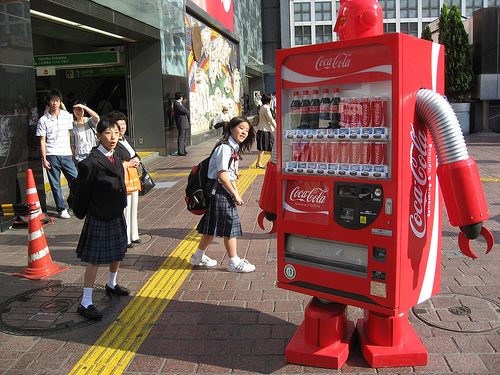
A Coke vending machine robot walks around Shibuya Station in Tokyo:


According to Tracy Jones in a web article titled "Jidoohanbaiki - Japanese Vending Machines, "the real surge in interest in jidoohanbaiki began during the Tokyo Olympics in 1964 with the need to supply large numbers

Japan's Neon Vision Lights Up the Night

Urban Life in a Neon Forest

Japan digital photography

One of the most enduring images people have of Japan is the riot of multicolored neon light that illuminates major city centers with a vibrant nighttime glow.

What looks like a gaudy collection of signs during daylight hours:


Little-Known Facts About Japan

Japan 
digital photography

Everything you always wanted to know about Japan,
but did not know where to ask


Well, now you have a website, called "JAPAN SAQ" (SELDOM ASKED QUESTIONS), which promises to answer ALL your questions, no matter how half-formed or strange-sounding they might be. For example:

Q. I have long wondered why Japan is called 'Japan' in English. I know why Korea is called Korea, despite it being Hanguk in Korean, can you enlighten me about the etymology of 'Japan'--why not 'Nihon'?

A. The word Japan probably comes from Portuguese or Dutch. Sailors, traders and missionaries from Portugal were the first westerners to visit Japan and they were already calling the country 'Zipangu' or "Jipangu" because they had heard the country called 'Jihpenkuo' in northern China. Another theory is that the word comes from the Dutch word "Japan", which is taken from "Yatpun", the name for Japan which is used in southern China. Because the name was given before the days of political correctness, the Portuguese and Dutch had little interest in using the Japanese words, "Nippon" or "Nihon".
-----

Q. Why all the cherry trees and no cherries?

A. There are two types of "cherry" trees. One type is bred for its beautiful blossoms (sakura) and the other for its fruit (sakuranbo). If you look closely, you will notice that the cherry trees with beautiful blossoms do have tiny cherries.
-----

Q. Why do Japanese people say that women deliver their babies in the TENTH month?

A. No, Japanese babies don't take longer to mature. Japanese do not count calendar months, but instead think in terms of lunar months of exactly 28 days. Those few days at the end of each of the 9 months count together for one extra month, hence ten months. (pregnancy is 40 weeks = 10 * 4 weeks = '10 months)".
-----

Q. "Why do Japanese people say that they have blue traffic lights when they are really green?"

A. According to the book, Japan From A to Z: Mysteries of Everyday Life Explained by James and Michiko Vardaman, the first traffic signals in Japan were blue instead of green, but the blue lights were difficult to see from a long distance away so they were replaced with green ones. Vardaman says that the custom of referring to traffic lights is a holdover from those days.
This sounds like a good explanation, but the problem with it is that you will hear Japanese people refer to other green things (like cucumbers, spinach, and sometimes grass) as being blue as well. This is because historically, Japanese people considered green to be a shade of blue. For example, the Chinese character for blue, pronounced ao is made up of two characters, iki (life) and i (well) and refers to the colour of plants which grow around a well, a colour between green and blue. When Chinese people see the character, they say it means green, but Japanese people say it means blue. Japanese books on colours tell us that there are four tertiary colours: red, blue, white and black, and that all others are shades of those four main ones. Ao, therefore, is a sort of ideal blue, halfway between green and blue. The sky is said to be blue, but it